


The attribution model that is costing most DTC brands 20% of their acquisition budget
[…]

Most ecommerce brands try to grow by adding more traffic.
CRO takes a different approach: make more of what you already have.
At Expose Growth, our ecommerce CRO services focus on improving conversion efficiency across your site — from first interaction through to checkout and repeat purchase. We treat CRO as a growth lever, not a design exercise or a series of random tests.
Better conversion doesn’t just increase revenue.
It improves every other channel connected to it.
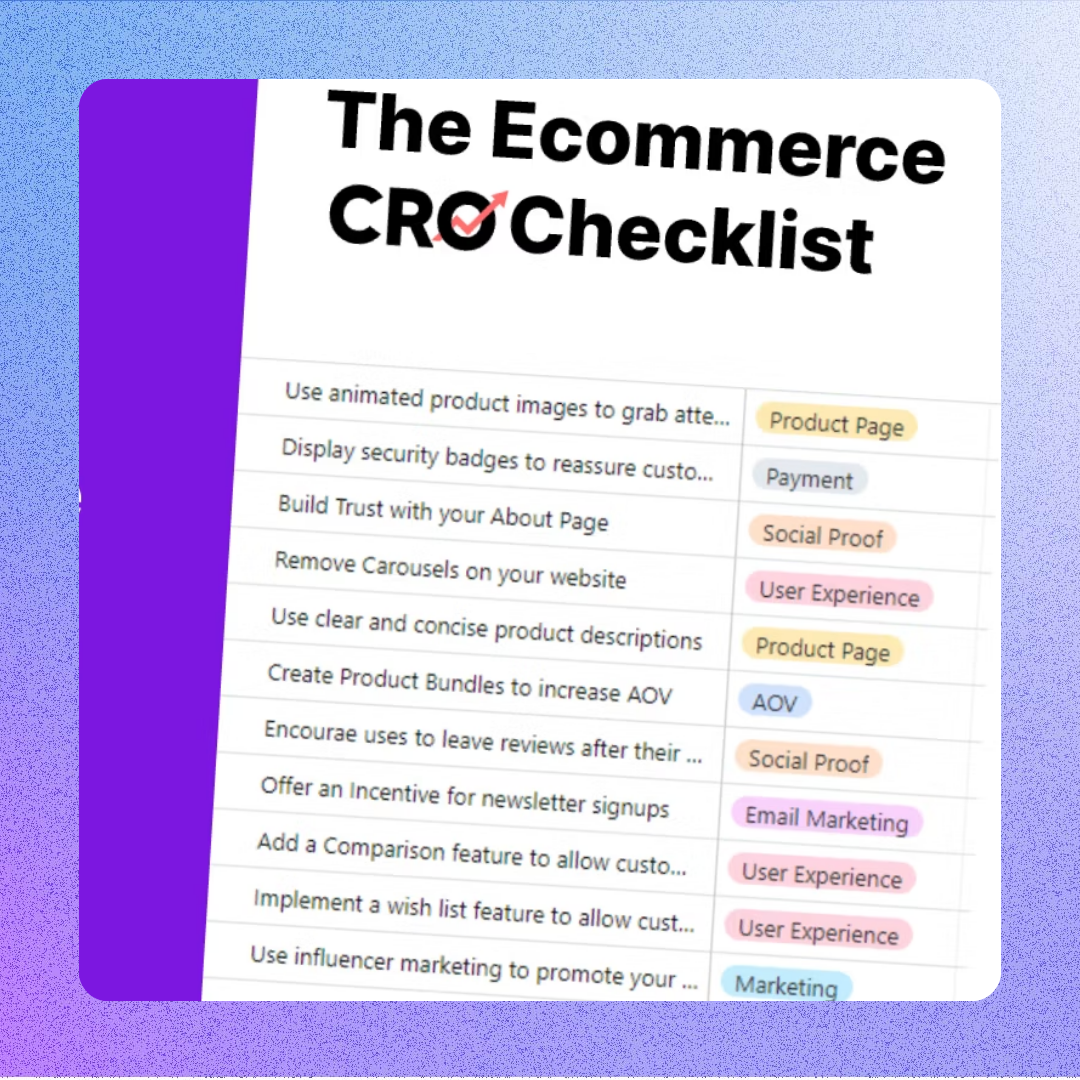
Find growth gaps yourself Explore the Growth Hub.

CRO is one of the most powerful growth disciplines — and one of the most misused.
Common issues we see include:
• Testing without a clear hypothesis — running experiments because “we should be testing” rather than because you have a specific theory about why conversion is low and a measurable way to test it
• Focusing on button colours instead of behaviour — the CRO myth that colour changes and micro-tweaks move conversion rate. They almost never do. Behaviour does.
• Optimising pages in isolation — improving the product page without considering what traffic source sent the visitor, what their intent was, and what happens if they don’t convert immediately
• Ignoring traffic source and intent — a visitor arriving from a branded Google search has completely different intent to one arriving from a cold Meta ad. Treating them the same way means your conversion rate is an average that accurately describes nobody
• Running experiments without enough data — declaring a winner after 50 conversions when you need 500 to reach statistical significance. This leads to implementing changes that are noise, not signal
The result is inconclusive tests, slow progress, and a creeping belief that CRO doesn’t work. It does work — when it’s done with the right methodology. That’s what we bring.

Effective CRO is not about tricks. It's not about button colours, countdown timers, or pop-ups that annoy visitors into converting once and never returning.
When CRO is done well it does five things simultaneously: it increases revenue without increasing ad spend, it improves paid media efficiency by making every click worth more, it supports SEO by reducing bounce rate and improving engagement signals, it strengthens retention by removing friction from the post-purchase experience, and it compounds — every improvement makes the next one easier to achieve.
That's why CRO sits at the centre of the growth system. It's the multiplier that makes every other channel perform better.
We structure our CRO work around five areas, each addressing a specific type of conversion gap we consistently find in Shopify and DTC stores.
CRO starts with understanding why users behave the way they do. We analyse:
Most CRO programmes fail because they skip this stage. They go straight to testing ideas that feel right rather than testing hypotheses grounded in what visitors are actually doing. Research is what separates CRO that compounds from CRO that wastes everyone’s time.


Every test should answer a question. We focus on:
A CRO programme without this structure produces random insights at random intervals. With it, you build a compounding body of knowledge about your customers — what they respond to, what puts them off, and what your highest-converting experience looks like. That knowledge is a genuine business asset.
CRO is not limited to a single page. We optimise across:
Small improvements across the journey often outperform big changes in one place. A 10% improvement at five points in the funnel compounds to a 61% improvement in overall conversion — which is why journey-wide CRO consistently outperforms page-specific CRO.

Many conversion problems are messaging problems.
We help brands:
This improves conversion without relying on discounts. Discounts train customers to wait for offers and compress your margins permanently. Messaging and offer clarity create conversion improvement that costs nothing and compounds indefinitely.
CRO without measurement is guesswork.
We focus on:
The goal is continuous improvement — not one-off wins. A single successful A/B test is an event. A structured CRO programme is a competitive advantage that compounds every quarter.
Every CRO engagement starts with an audit and research phase before any testing begins. Here’s what most engagements cover across a full programme:
• CRO audit — a full review of your site identifying the specific friction points, messaging gaps, and experience failures costing you conversion rate. Prioritised by traffic impact and revenue opportunity
• Behaviour research — heatmaps, session recordings, user journey analysis, and qualitative research to understand why visitors aren’t converting
• Testing roadmap — a structured 90-day experimentation plan with prioritised hypotheses, success metrics, and resource requirements
• Experiment design and build — creating test variants, writing briefs for development, and ensuring QA before any experiment goes live
• A/B and multivariate testing — running controlled experiments with appropriate sample sizes and statistical rigour
• Landing page optimisation — for paid traffic specifically, improving the post-click experience to maximise return on ad spend
• Checkout optimisation — reducing abandonment at the final step through trust signals, friction removal, and payment option strategy
• Performance reporting — clear reporting on what was tested, what was learned, and what the revenue impact of each change was
Some brands start with a one-off CRO audit to understand where the gaps are, then action it internally. Others bring us in for ongoing experimentation. Both are valid starting points — what matters is that optimisation is happening systematically, not reactively.
Shopify stores have a distinct set of conversion challenges that come with the platform. Understanding them is the difference between generic CRO advice and optimisation that actually moves the needle for your specific setup.
Here are the most common Shopify conversion gaps we find in stores we audit:
Theme performance and page speed — Many Shopify themes, particularly heavily customised or app-loaded ones, have significant Core Web Vitals issues. A one-second improvement in page load time can increase conversion rate by 7%. We identify and fix the specific app conflicts, image loading issues, and render-blocking scripts causing speed problems on your store.
Collection page structure and filtering — Most Shopify collection pages are not optimised for conversion. Default sorting shows products in arbitrary order, filtering options create confusing navigation patterns, and category descriptions are either missing or generic. These pages are often the highest-traffic pages on the site and the most underoptimised.
Product page anatomy — Shopify product pages have consistent conversion problems across stores: reviews that are buried below the fold, add-to-cart buttons that aren’t prominent on mobile, shipping and returns information that’s hidden in accordions instead of visible above the fold, and cross-sell recommendations that fire too early in the decision process. We audit every element systematically.
Checkout abandonment — Shopify’s checkout is largely fixed, but the pre-checkout experience — cart page design, trust signals in the mini-cart, the prominence of free shipping thresholds — is fully customisable and frequently unconverted. The transition from “add to cart” to “complete purchase” loses a significant percentage of buyers on most stores.
App conflicts and UX fragmentation — Most Shopify stores have accumulated review apps, loyalty apps, upsell apps, popup apps, and subscription apps that each add their own UI elements. The result is a fragmented, inconsistent user experience that erodes trust. We audit the full app stack for UX impact alongside technical performance.
Mobile checkout experience — Shopify’s mobile checkout is better than most custom builds, but the journey from landing page to checkout is often not optimised for mobile. Sticky add-to-cart bars, mobile-specific image formats, and touch-target sizing all matter and are frequently overlooked.
The Growth Hub contains CRO frameworks, experiment planning templates, and conversion audit checklists built specifically for ecommerce stores. If you want to start finding and fixing your conversion gaps independently before bringing in external support, it's the most structured way to do it without guesswork.
Step-by-step systems for launch, growth, and retention
Self-guided learning on funnels, AARRR, and more
Checklists and frameworks ready to use today
Some CRO interventions show results within days — fixing a broken checkout step, improving mobile page speed, or making a value proposition clearer above the fold can produce measurable conversion improvement almost immediately. Structured A/B testing takes longer: you need two to four weeks of runtime minimum on most Shopify stores to reach statistical significance, and a full quarter of testing to start seeing compounding results. The honest answer is that CRO is a 90-day programme before it's a reliable growth channel — but the improvements are permanent, unlike paid media which stops the moment you stop spending.
Traffic volume affects how quickly you can run A/B tests. As a general guide, you need at least 1,000 visitors per variant per week to run a meaningful experiment — which means a store doing fewer than 5,000 monthly sessions will struggle to A/B test effectively. However, CRO is not just A/B testing. Audit-based CRO — identifying and fixing clear conversion problems without running controlled experiments — can be done on any traffic level and often delivers the fastest wins. For lower-traffic stores, we prioritise fixing obvious friction points through expert review before building an experimentation roadmap.
Yes — and a CRO audit is often the most valuable starting point. A full audit tells you exactly where your store is losing conversion rate, which pages have the biggest gaps, and what to fix first. Some brands take that audit and implement internally. Others use it as the foundation for an ongoing testing programme with us. If you want to start with an audit and see what we find before committing to anything longer-term, that's a completely reasonable approach. Book a free 30-minute discovery call and we'll explain what a CRO audit would cover for your specific store.
We measure CRO success primarily on revenue per visitor and conversion rate improvement, tracked against a pre-test baseline. We also track add-to-cart rate, checkout initiation rate, and checkout completion rate separately — because a drop in any one of these tells you something specific about where friction exists. Win rate (the percentage of tests that produce a statistically significant positive result) is a secondary metric — it matters, but a programme with a 30% win rate that generates large learning from the other 70% is more valuable than one with a high win rate producing tiny improvements. Ultimately, the question we ask is: is revenue per visitor trending upward quarter on quarter? That's the number that tells you whether CRO is working.
A redesign changes everything at once based on opinions and aesthetic preferences — and because everything changes simultaneously, you have no way of knowing what actually moved the needle. If conversion rate improves after a redesign, you don't know why. If it falls, you don't know what caused it. CRO is the opposite approach: systematic, evidence-based changes to specific elements, tested in controlled conditions, with clear before-and-after measurement. Redesigns can be valuable for brand reasons — but they're not CRO. We sometimes recommend redesigning specific pages based on CRO research, but always as a tested hypothesis rather than an aesthetic judgment.
It depends on what you're testing and how you're interpreting results. The most common problems we see in brands already running tests: experiments without clear hypotheses (testing ideas rather than answering questions), stopping tests too early and implementing winners that are actually noise, testing low-impact elements (button colours, font sizes) instead of high-impact ones (value proposition, trust signals, checkout structure), and not applying learnings beyond the specific page tested. If any of those sound familiar, there's significant value in auditing your current testing programme. We often improve CRO velocity and result quality substantially in brands that are already testing but not getting compounding results.
Book a free 30-minute CRO audit. We'll look at your store's conversion funnel, identify the specific pages and steps losing you revenue, and tell you exactly what to fix first. More revenue from the traffic you already have — no extra ad spend required.
Adding {{itemName}} to cart
Added {{itemName}} to cart

