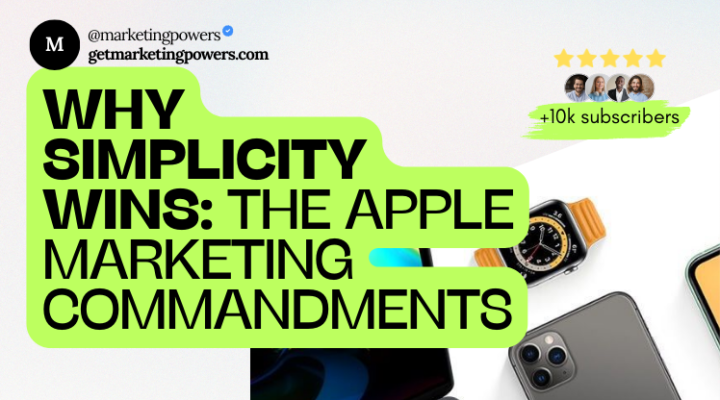
Why Simplicity Wins: The Apple Marketing Commandments
[…]





In 2026, Shopify stores win Google Shopping free listings by feeding Google clean product data, accurate pricing and availability, strong merchant trust signals, and conversion-ready landing pages. Success comes from disciplined feed structure, realistic optimisation (not hacks), and validating performance through impressions, clicks, and assisted revenue—not ads alone.
| Layer | Goal | What Matters in 2026 | Common Mistake |
|---|---|---|---|
| Feed quality | Eligibility | Accurate, complete attributes | Auto-only feeds |
| Merchant trust | Visibility | Policies + consistency | Missing info |
| Product data | Relevance | Titles + GTINs | Keyword stuffing |
| Landing pages | Performance | Fast, clear, honest | Mismatch |
| Measurement | Validation | Assisted revenue | Clicks only |
Free listings surface eligible products organically across Google Shopping, Search, Images, and AI Overviews—without ad spend.
From hands-on work with Shopify merchants, free listings work when Google can:
Trust your store
Understand your products
Match items to intent
If any one of those fails, visibility collapses.
Eligibility is binary—either you qualify or you don’t.
Baseline requirements:
Google Merchant Center account
Verified and claimed domain
Active product feed
Accurate pricing, availability, shipping
Clear refund and contact policies
Most stores fail here—not at “optimisation.”
Use native Shopify + Google integration first. Custom feeds come later.
Recommended setup order:
Connect Shopify to Google Merchant Center
Enable free listings
Sync all products initially
Audit disapproved items
Prune low-quality SKUs
Start broad, then refine.
These settings affect trust more than most people realise.
Critical Merchant Center checks:
Accurate business information
Matching domain + checkout
Realistic shipping times
Transparent return policy
If policies don’t match checkout reality, products get suppressed.
Titles are the #1 relevance signal.
High-performing title structure:
Brand
Product type
Key attribute (size, material, model)
Variant (only if meaningful)
Example:
Brand + “Running Shoes” + “Trail” + “Waterproof”
Avoid promotional language—Google ignores it.
Completeness beats creativity.
High-impact attributes:
GTIN / UPC
Brand
Product category (Google taxonomy)
Price + availability
Condition
Shipping
Missing GTINs dramatically reduce exposure.
Descriptions support context, not rankings.
Best practices:
Plain language
Use-case focused
No keyword stuffing
Match landing page copy
Discrepancies trigger disapprovals.
Google Shopping isn’t just search—it’s recommendation.
Trust signals include:
Policy clarity
Review signals
Consistent data across web
Low return/refund disputes
From experience, stores with weak trust plateau fast—even with perfect feeds.
They’re indirect but powerful.
Reviews help by:
Increasing click-through
Improving user satisfaction
Reinforcing brand legitimacy
Google doesn’t need perfect ratings—authentic volume matters more.
Landing pages must match the feed exactly.
Non-negotiables:
Same price
Same availability
Same product
Clear shipping + returns
Mismatch = suppression or account warnings.
Shopping users are ready but cautious.
High-converting Shopping pages include:
Clear above-the-fold value
Fast load times
Trust elements visible immediately
Simple variant selection
No aggressive popups
Shopping traffic punishes friction.
No—and that’s a major lever.
Exclude products that:
Never get impressions
Have poor margins
Generate returns
Cause feed errors
Fewer, higher-quality SKUs often outperform bloated catalogs.
They help Google understand context.
Best practices:
Use Google’s taxonomy accurately
Avoid “miscellaneous” categories
Keep product_type consistent
This improves matching in AI-driven results.
AI Overviews increasingly reference products, not just pages.
Products that surface:
Have clean data
Match buyer intent
Link to trustworthy stores
Shopping optimisation is now part of Answer Engine Optimisation.
This is the workflow I use:
Monthly optimisation checklist:
Review disapprovals and warnings
Optimise top 20 product titles
Remove low-performing SKUs
Validate pricing and shipping accuracy
Compare impressions vs revenue
Consistency beats one-off tweaks.
AI is useful for:
Drafting titles
Summarising attributes
Spotting inconsistencies
AI should never override Merchant Center policies.
Leading indicators:
Product impressions
Impression share by category
Click-through rate
Disapproval rate
Lagging indicators:
Assisted revenue
Revenue per product
Brand search lift
Conversion rate from Shopping traffic
Clicks without revenue are noise.
From real Shopify stores:
Most issues come from policy mismatches, not feeds
Titles matter more than descriptions
Fewer SKUs often outperform full catalogs
Shipping accuracy affects visibility more than price
Free listings reward operational discipline
The biggest gains usually come from fixing basics relentlessly.
Are Google Shopping free listings worth it?
Yes. They often drive high-intent traffic with strong conversion rates.
Do free listings replace paid Shopping ads?
No. They complement ads and improve total visibility.
How long does it take to see results?
Impressions often appear within days once approved.
Do I need GTINs for all products?
Ideally yes—missing GTINs limit reach.
Can small Shopify stores compete?
Yes. Data accuracy matters more than brand size.
Does schema help Google Shopping?
Indirectly—feed data is more important.
Should I optimise for clicks or revenue?
Revenue. Clicks alone are misleading.