
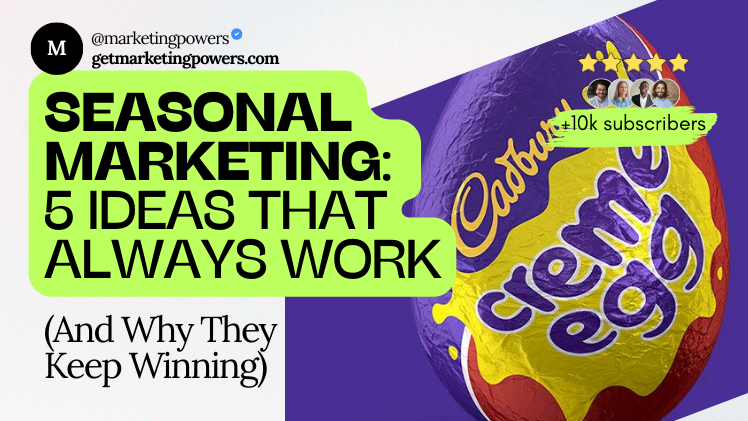
Seasonal Marketing: 5 Ideas That Always Work
Seasonal marketing works when it aligns timing, emotion, and customer habit. The five ideas that always win are ritualized launches, seasonal anchors, predictable scarcity, memory-based storytelling, and post-season continuity. Executed correctly, these approaches drive repeat demand, higher conversion, and lower acquisition costs year after year.
Why does seasonal marketing outperform always-on campaigns?
Before tactics, here’s the structural reason seasonal marketing keeps winning:
| Growth Lever | Always-On Marketing | Seasonal Marketing |
|---|---|---|
| Attention | Constant competition | Built-in relevance |
| Urgency | Artificial | Time-bound by nature |
| Emotion | Neutral | Emotionally primed |
| Customer behavior | Interruptive | Habitual & anticipatory |
| ROI over time | Flat | Compounding |
The insight: Seasonal marketing works because customers are already paying attention.
How have I seen seasonal marketing outperform “evergreen” strategies in real businesses?
I’ve led and advised seasonal campaigns across DTC, SaaS, and retail. When done right, seasonal initiatives consistently outperform evergreen efforts on:
- Conversion rate
- Email engagement
- Repeat purchase
- Organic sharing
Not because they’re louder—but because they’re on time.
Seasonality isn’t a gimmick.
It’s behavioral alignment.
Below are the five seasonal marketing ideas I’ve seen work across industries, cycles, and budgets—even when everything else failed.
Idea #1: How does ritualized timing turn launches into habits?
Why timing beats creativity
The most effective seasonal campaigns don’t surprise customers.
They arrive when expected.
Ritualized timing works because it:
- Trains anticipation
- Reduces decision friction
- Turns the calendar into a reminder
Customers don’t ask, “Should I buy this?”
They ask, “Is it back yet?”
How to implement ritualized timing
- Anchor launches to specific calendar moments
- Keep the timing consistent year over year
- Signal returns early and clearly
Key rule:
If it moves every year, it’s not a ritual—it’s a promotion.
Idea #2: How do seasonal anchors simplify decision-making and boost conversion?
Why one seasonal hero beats ten themed offers
Most brands overcomplicate seasonal marketing by launching:
- Too many SKUs
- Too many messages
- Too many variations
High-performing seasonal campaigns almost always center on one anchor offer.
This anchor:
- Represents the season emotionally
- Carries the narrative
- Becomes recognizable over time
How anchors increase performance
- Reduce cognitive load
- Improve recall year to year
- Create brand ownership of a moment
I’ve repeatedly seen single-anchor seasonal campaigns outperform multi-offer collections in both AOV and retention.
Clarity beats abundance—especially during noisy seasons.
Idea #3: How does predictable scarcity create urgency without eroding trust?
Why scarcity only works when it’s expected
Seasonal scarcity succeeds because it’s:
- Temporary
- Understandable
- Fair
Customers accept limited availability when it’s tied to time, not manipulation.
The difference:
- Bad scarcity: “Last chance! Extended!”
- Good scarcity: “This season only—back next year.”
How to use predictable scarcity correctly
- Define a clear availability window
- Communicate the end date calmly
- Honor the cutoff every time
Critical insight:
Scarcity spends trust. Predictability replenishes it.
Brands that break their own scarcity rules see diminishing returns every season after.
Idea #4: How does memory-based storytelling turn seasons into revenue loops?
Why nostalgia outperforms novelty
Seasonal marketing works best when it references previous seasons.
Not just thematically—but explicitly.
Memory-based storytelling:
- Rewards returning customers
- Increases emotional value
- Reduces relearning costs
Customers love hearing:
- “You loved this last winter…”
- “Back again, just like last year”
- “You know what season this is”
How to implement memory loops
- Reference past launches in current campaigns
- Use consistent naming and visuals
- Let returning customers feel “ahead”
This turns each season into a compounding asset, not a reset.
Idea #5: How does post-season continuity extend value beyond the calendar?
Why most brands waste their best seasonal momentum
The biggest seasonal mistake I see:
Treating the end of the season as the end of the story.
High-performing brands use post-season moments to:
- Transition customers forward
- Set expectations for what’s next
- Preserve emotional momentum
What post-season continuity looks like
- “Until next season” messaging
- Behind-the-scenes reflections
- Early signals of the next cycle
This keeps customers emotionally invested, even when the product is gone.
Seasonality should create pauses—not drop-offs.
How do these five ideas work together as a system?
Seasonal marketing fails when ideas are used in isolation.
It succeeds when they reinforce each other:
- Ritualized timing creates anticipation
- Seasonal anchors simplify choice
- Predictable scarcity drives urgency
- Memory-based storytelling rewards loyalty
- Post-season continuity preserves momentum
Together, they form a loop that gets stronger every year.
Field Notes: Lessons Learned From Seasonal Campaigns That Actually Worked
These insights come from campaigns that survived budget cuts, platform changes, and market shifts.
Lesson 1: Fewer seasons, executed better, outperform constant “seasonal” noise
Brands that tried to attach themselves to every holiday diluted impact fast.
The strongest results came from owning one or two seasonal moments deeply.
Depth beats frequency.
Lesson 2: Seasonal marketing fails fastest when it’s reactive
Campaigns built because “everyone else is doing it” consistently underperformed.
Seasonality works when it aligns with:
- Product truth
- Customer behavior
- Brand timing
Not trends.
Lesson 3: Customers forgive absence—but not inconsistency
Pausing a seasonal campaign is less damaging than:
- Changing timing
- Breaking scarcity promises
- Renaming anchors every year
Consistency builds memory.
Memory builds demand.
How can smaller teams implement seasonal marketing without massive resources?
What matters more than budget
Seasonal success depends more on:
- Discipline
- Repetition
- Confidence
Than on production value.
Small teams can win by:
- Choosing one moment
- Repeating it annually
- Improving execution incrementally
Seasonal marketing scales down extremely well.
FAQ: Seasonal Marketing That Always Works
What is seasonal marketing?
Seasonal marketing aligns campaigns with predictable calendar moments to leverage built-in customer attention, emotion, and urgency.
Why does seasonal marketing perform better than evergreen campaigns?
Because it works with existing customer behavior instead of interrupting it.
How many seasonal campaigns should a brand run per year?
Most brands perform best with 1–3 core seasonal moments, not constant seasonalization.
Does seasonal marketing work outside retail?
Yes. SaaS, education, media, and services all benefit from time-based relevance and habit formation.
What’s the biggest mistake brands make with seasonal marketing?
Treating it as a short-term promotion instead of a long-term system.
Final takeaway
Seasonal marketing doesn’t work because it’s clever.
It works because it’s human.
People live by calendars, memories, and rituals—not ad schedules.
Align your marketing with time itself, and you don’t have to fight for attention.
You inherit it.